Nutrition
Back to School Hacks: Lunchbox Recommendations from Hanna
Top kids lunchbox picks from our office manager who holds a nutrition certificate.
Lunches can be hard. They have to stay fresh through a hot bus and a morning in a classroom with nothing but an ice pack, and then they have to actually get eaten by a child who has twenty minutes and better things to do.
So we sat down with Hanna, our favorite office manager, who holds a certificate in nutrition, and asked for her top lunchbox picks for back to school.
Her answer started with one number and one nutrient.
Protein is the part of the lunchbox that holds a kid to three o'clock
A child's protein target for a whole day is about 19 grams at ages 4 to 8, about 34 grams at 9 to 13, and 46 grams for girls and 52 for boys at 14 to 18. Lunch should be carrying somewhere near a third of that, which puts most elementary schoolers around 10 to 15 grams in the box and most middle schoolers closer to 15 to 20.
The reason it has to be protein specifically is mechanical. Protein slows how fast the meal leaves the stomach, and the amino acids landing in the small intestine trigger the release of CCK, GLP-1 and PYY, the gut hormones that report back to the brain that the body has been fed. At the same time, ghrelin (the hormone that says go find food) drops. Protein is the most satiating of the three macronutrients and the most thermogenic, which is a technical way of saying it does the most work per bite and keeps doing it longest.
A lunch that is bread, fruit snacks and a juice box will absolutely be eaten. It just runs out around one o'clock, which is the hour Hanna hears about from parents the most.
Hanna's picks, with the grams so you can build to a number
Approximate grams, so you can build to the number instead of guessing:
- Two hard-boiled eggs. About 12 g.
- Three ounces of leftover rotisserie chicken. About 24 g.
- A small pouch of tuna with crackers on the side. About 20 g.
- Turkey roll-ups, three or four slices. About 10 g.
- A small Greek yogurt. About 15 g.
- Half a cup of cottage cheese. About 12 g.
- An ounce of cheddar, cubed. About 7 g.
- Half a cup of shelled edamame. About 9 g.
- Half a cup of chickpeas, roasted or plain. About 7 g.
- A quarter cup of pumpkin seeds. About 9 g.
- Two tablespoons of peanut butter. About 7 g.
- An ounce of beef stick or jerky. About 9 g.
Two of those in a box gets almost any elementary schooler where he or she needs to be. Hanna's own rule is that one of the two has to be something the kid would have chosen. A lunch built entirely out of nutrition gets traded at the table, and then none of it counts.
A dairy-free box carries just as much protein once you know the swaps
This is where most families get stuck, because the fast protein defaults (cheese stick, yogurt tube, milk) are all dairy. Swap in these and the numbers hold:
- Edamame in the pod, salted, eaten like a fidget toy. About 9 g per half cup.
- Hummus with pita and pepper strips. About 5 g per quarter cup of hummus.
- Black beans and avocado in a tortilla, cut into rounds. About 7 g per half cup of beans.
- Sunflower seed butter on whole grain, which is also the nut-free classroom answer. About 6 g per two tablespoons.
- Roasted chickpeas, which travel better than almost anything. About 7 g per half cup.
- Chicken or turkey skewers on a toothpick. About 8 g per ounce.
- Lentil or chickpea pasta salad with olive oil and cut vegetables. About 12 g per cup cooked.
Worth knowing on the milk substitutes: almond, oat, rice and coconut milks are mostly carbohydrate and fat, and a box of almond milk is contributing about 1 gram. Fine as a drink. Not the protein.
A thermos unlocks every hot leftover you already have in the fridge
Hanna's single strongest recommendation is a wide-mouth insulated thermos, because it takes the entire hot-leftovers category and makes it packable.
Preheat it with boiling water for five minutes, dump the water, then load it hot. Chili, taco meat, meatballs, soup, chicken and rice, last night's pasta with the sauce already on it. A kid who will not touch a cold sandwich will very often eat the thing he or she already liked at dinner, and it arrives at 11:40 still warm.
It also solves the meal that has the most protein in it and the least ability to survive an insulated bag.
What we send home when the box can only do so much
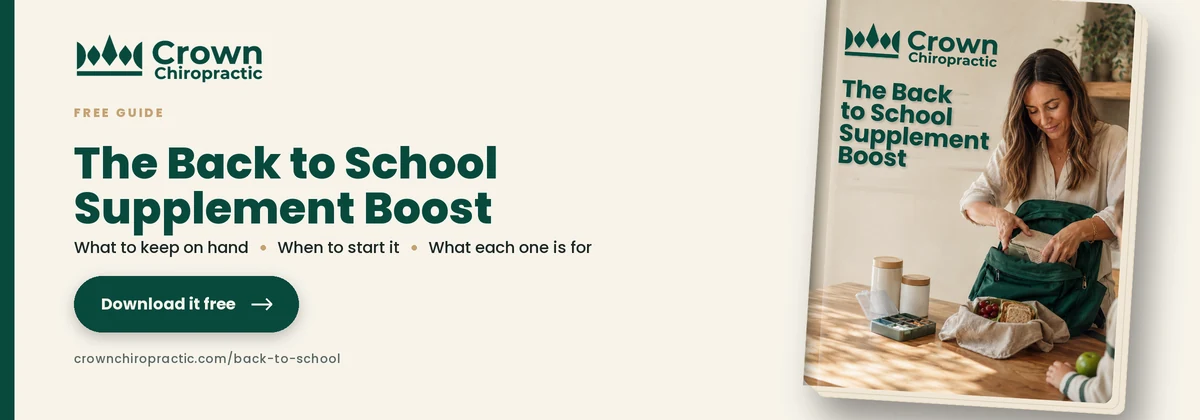
Some weeks the lunch is a granola bar and an apology, and the school year does not pause for it. The guide we put together covers what we reach for at Crown across immune support, focus and the calm-and-sleep end, sorted by whether your child can swallow a capsule yet.
Book a Back to School Realignment and bring the lunchbox question with you
If the box comes home full no matter what is in it, or your child's list of accepted foods keeps getting shorter, or every morning starts with a stomachache before the bus and you have stopped being able to tell whether that is food or nerves, that is the conversation to bring in.
A Back to School Realignment with Dr. Diego Torres is a gentle pediatric visit built for this stretch of the calendar. He starts with how your child's body is actually handling the load of the week, and there is room in it to walk through the food and the lunchbox alongside everything else, because at this age the two are rarely separate. You can also read about Nutrition Response Testing and functional medicine at Crown.
Call (239) 441-2275 and ask for a Back to School Realignment with Dr. Diego. New patients book this one by phone.
You are allowed to stop treating this like a nightly test you keep failing. Bring us the kid you actually have and we will build the week around him or her.
Sources
Dietary Reference Intakes for protein, Food and Nutrition Board, National Academies (RDAs by age) · Revisiting the role of protein-induced satiation and satiety, Food Hydrocolloids 2017 · Appetite control and gastrointestinal hormonal behavior (CCK, GLP-1, PYY 1-36), Nutrition, Metabolism and Cardiovascular Diseases · USDA FoodData Central (per-serving protein values) · Harvard Nutrition Source, Kid's Healthy Eating Plate · FDA and USDA guidance on plant-based milk alternatives and protein content
Good to know
Questions parents ask
How much protein does my child need at lunch?
Roughly a third of the daily target: about 10 to 15 grams for elementary schoolers and 15 to 20 for middle schoolers. Daily totals are about 19 grams at ages 4 to 8, 34 grams at 9 to 13, and 46 to 52 grams at 14 to 18.
Why does protein keep kids full longer?
It slows stomach emptying and triggers CCK, GLP-1 and PYY, the gut hormones that signal the brain the body has been fed, while lowering ghrelin. It is the most satiating of the three macronutrients.
What are good dairy-free school lunch ideas?
Edamame, hummus, black beans, roasted chickpeas, sunflower seed butter, chicken skewers, and lentil or chickpea pasta. Plant milks are mostly carbohydrate and fat, so build the protein out of the food rather than the drink.
How do I keep hot food hot in a lunchbox?
Preheat a wide-mouth insulated thermos with boiling water for five minutes, pour it out, then fill it with food that is hot when it goes in.
What is a high protein lunch for a picky eater?
Start from the two or three proteins the child already accepts and build around those, and always include one item he or she would have chosen. Novelty goes in beside the safe food in small amounts, without commentary.
Wear your crown
Book a Back to School Realignment with Dr. Diego
A gentle pediatric visit built for the first stretch of the school year. Call and our team will get you in with Dr. Diego Torres. New patients welcome.